Post-close integration, a carve-out or separation, an IT finding that surfaced in diligence, or a value creation plan that assumes an operations function nobody has built yet.
Mid-market, owner or founder led
A CEO or COO who owns technology without being technical. A customer security questionnaire you cannot answer, an outage your customers noticed first, a cloud bill nobody can explain.
Bootstrapped and scaling
Growing past what the founding engineer can personally hold. A first enterprise customer asking for SOC 2. A first real hire into IT operations.
The common thread: a technology function that grew rather than one that was designed.
What actually transfers
Scale does not transfer. Three things do.
1
Seen it before.
I have watched technology fail across financial services, manufacturing, consumer goods, and a private equity carve-out. In a small IT shop every problem looks equally urgent, and the cost of that is misallocated attention. Knowing which fire is actually urgent is the scarcest thing a mid-market company can buy.
2
Commercial leverage.
I have negotiated more than $500M in contracts, including the renegotiation of a $400M infrastructure outsourcing agreement and commercial management of a $150M per year contract. Cloud and vendor spend is frequently your second largest expense line, and nobody on staff has sat on the buy side of a real negotiation.
3
The translation layer.
Presenting risk posture and formal risk downgrades to executive committees at a global bank is the same skill as telling a COO who owns technology the truth about their platform. Your board, your auditors, and your largest customer all need an answer they can act on.
The disciplines are inexpensive. The enterprise versions of them are what cost money. A 90-person company does not need a 40-page change management policy. It needs a repeatable way to keep a Friday deployment from taking down production.
In the field
Fractional CTO for a mortgage technology SaaS company.
Fractional CTO and infrastructure lead · Reporting to the COO · Since April 2026
I turned a set of scattered efforts into one managed plan covering network modernization, security remediation, and SOC 2 readiness. Leadership extended the engagement with expanded scope to drive execution.
5
cloud environments in the program
16
infrastructure risks assessed
9
SOC 2 criteria read for readiness
Visibility first. A weekly IT operational review with tracked actions and named owners, plus monthly leadership updates.
Security closed down. The highest-risk administrator account removed, stale accounts cleaned up, and MFA and email protection sequenced.
Network modernized. A hub-and-spoke rebuild planned and managed. New VPN gateway and private DNS resolver live, with exposed internet-facing ports closing as environments migrate across.
Risk made legible. An infrastructure risk register assessed and reviewed with leadership, plus a SOC 2 readiness approach with scope, method, and the gaps named and sequenced toward a Type 1 audit.
Platform kept current. Kubernetes moved to a supported version, the cache layer moved to a Microsoft-managed service, and automation went live with runbooks, logging and alerting.
How engagements work
Three ways to work together.
Operations & Risk Assessment
Roughly thirty days
Where you stand on reliability, security, cloud spend, vendors, and team capacity, with a prioritized plan leadership can fund.
Most engagements start here.
Fractional IT Leadership
A continuing engagement
Interim CTO or VP of Infrastructure for companies that need senior judgment without a senior salary.
Targeted Project
A named outcome with an end date
Incident management stood up, a vendor agreement renegotiated, a separation executed, SOC 2 readiness prepared.
How the work runs
01
Visibility
Findings, risks and inventory. What is really happening inside IT.
02
Structure
One program plan, a weekly cadence, named owners and dated commitments.
03
Execution
Tracked remediation and modernization, reported monthly to leadership.
04
Governance
Policies, risk register and processes built to audit standard.
05
Sustainability
Roles defined and processes running without the consultant in the loop.
A 225-person global organization, a $70 million budget, service desks on three continents, and infrastructure risk carried to the executive committees of a global bank. Every discipline here is one I have operated myself.
Infrastructure, end-user services, crisis response, and risk management across five industries and four continents at Coca-Cola, SunTrust, Voya Financial, Corning, Morgan Stanley, and Candescent. BS Information and Computer Science, Georgia Institute of Technology.
Insights
Thoughts from the field.
September 21, 2026
The 3 AM Phone Call
A manufacturing system had gone down in Asia. On paper, we were covered. In reality, the backup sat on the other end of a very slow circuit and could not carry the load. So we shipped the hardware.
Read more
July 27, 2026
"How Hands-On Are You?"
It is a fair question to ask a senior leader. So here is an answer, in the form of something I built: a full-stack data platform pulling six source systems into one place, running entirely on Cloudflare's edge.
Read more
July 13, 2026
Working From Home: The Real Setup
After 25+ years in IT leadership, you'd think my home office would look like something out of a tech magazine. It almost does. What you don't see on camera is a bowl of Spaghetti O's and a dog who has appointed herself Chief Security Officer.
Read more
June 22, 2026
Twelve Years at Coca-Cola, and What Staying Taught Me
I joined Coca-Cola in 1992 and stayed for twelve years. In a market where people often change jobs every two or three years, that can sound like a long time. I would say it was exactly right.
Read more
June 1, 2026
Operational Discipline at Small-Company Scale
A month into Timberline, what is standing out to me early on. Small companies can build the same operational discipline that large enterprises have, but it has to be shaped for the size of the company.
Read more
April 22, 2026
Vendor Governance Is Not Procurement
Vendor governance and procurement go hand in hand, but they are not the same thing. A few lessons from leading large vendor relationships across several companies.
Read more
April 16, 2026
Company Culture: What They Say vs. What You Experience
After 25+ years, I have come to believe that culture is not what is on the careers page. It may not be what the hiring manager tells you in the interview.
Read more
March 22, 2026
Business Travel: Get Out and See the World
I remember the first time I traveled for work. I was excited, energized, and ready to see the world. And so I went to Saskatoon, Saskatchewan, Canada.
Read more
March 15, 2026
Sharpening the Saw: Diving Into AI
With AI front and center of most people's minds, I have been diving deep into generative AI, prompt engineering, and agentic frameworks.
Read more
March 8, 2026
Taking a Deliberate Pause
Right after I left my last role, my first instinct was not to look ahead towards that next role. It was to clear my head.
Read more
September 21, 2026
The 3 AM Phone Call
The call came in at 3 AM.
A manufacturing system had gone down in Asia. It failed in the middle of their workday, which was the middle of our night. My team was in North America only at the time, so a problem on the other side of the world became a problem in our bedrooms.
Here is the part that has stuck with me. That system had a replicated backup in another city. On paper, we were covered. In reality, the backup sat on the other end of a very slow circuit and could not carry the load. Recovering over that link would have taken longer than putting the hardware in a box and shipping it to the other location. So that is what we did. We shipped the hardware.
Redundancy that only works on a diagram is not redundancy.
We were early in a major push to improve our people, processes, and technology. The technology gaps were real, but the bigger gaps were in how we worked, so that is where we focused. We tightened our processes so a major incident followed a known path instead of a scramble. We improved our communications so the business always knew what was happening, even when the news was bad. And we invested in relationships across the company, because in a real incident, speed comes from people who already trust each other.
You cannot build that trust at 3 AM. You build it in advance and draw on it when it counts.
Over time the numbers moved. Major incidents dropped and mean time to repair came down significantly. But the compliment I remember most did not come from a dashboard. It came from our CIO, who told us how much the communication from the team had improved. In an incident, people remember how it felt to be kept informed.
Before the improvements took hold, we burned people out, myself included, and one good person left in the middle of it. That is the part of operations leadership that does not make the highlight reel.
Here is what I believe after living through it more than once. If your best people are getting the 3 AM call over and over, that is not dedication. It is a signal. The job is not to be the hero who always answers. It is to build the systems, the processes, and the team so the phone rings less, and so the response is calm instead of frantic when it does.
Question for you: what is the one change that made the biggest difference in your incident response?
July 27, 2026
"How Hands-On Are You?"
It is a fair question to ask a senior leader. My recent roles have been technology strategy and leadership, but I never stopped being hands-on with the technology itself.
So here is an answer, in the form of something I built.
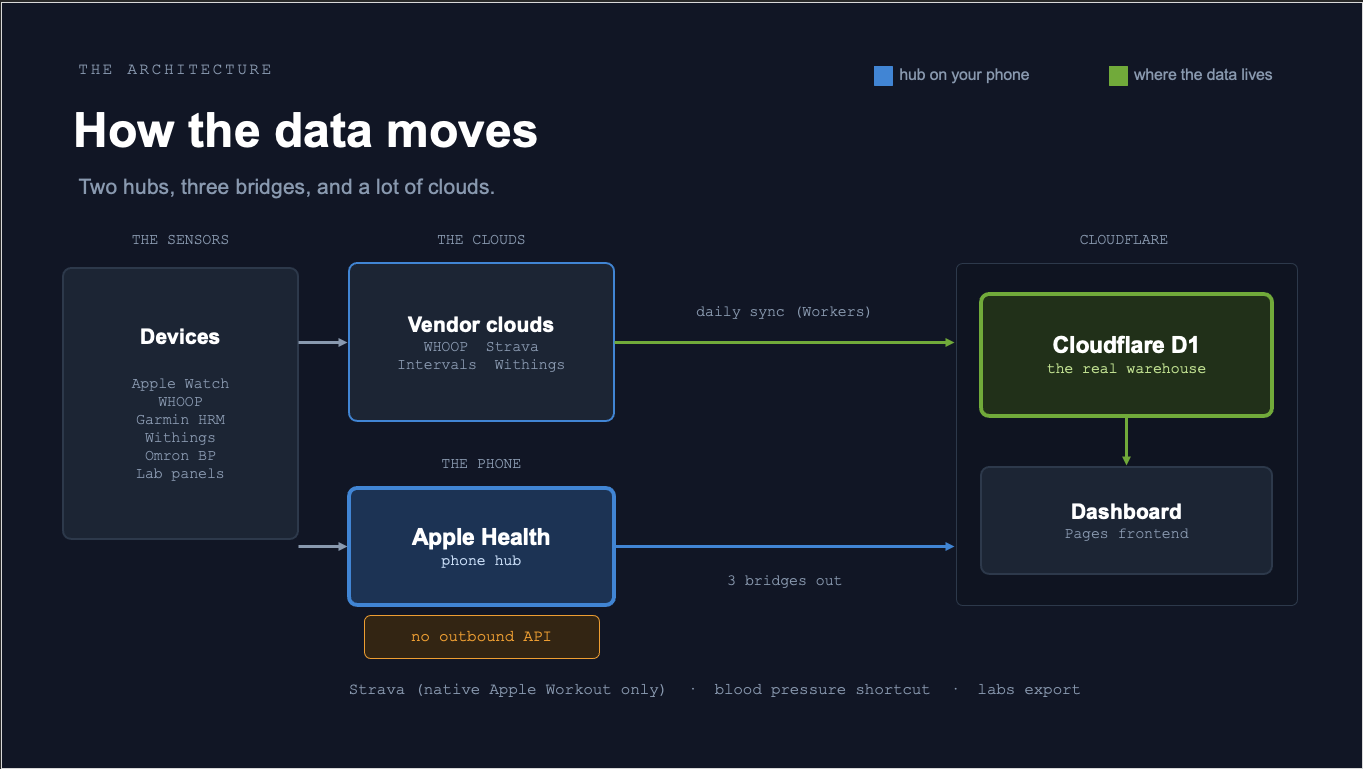
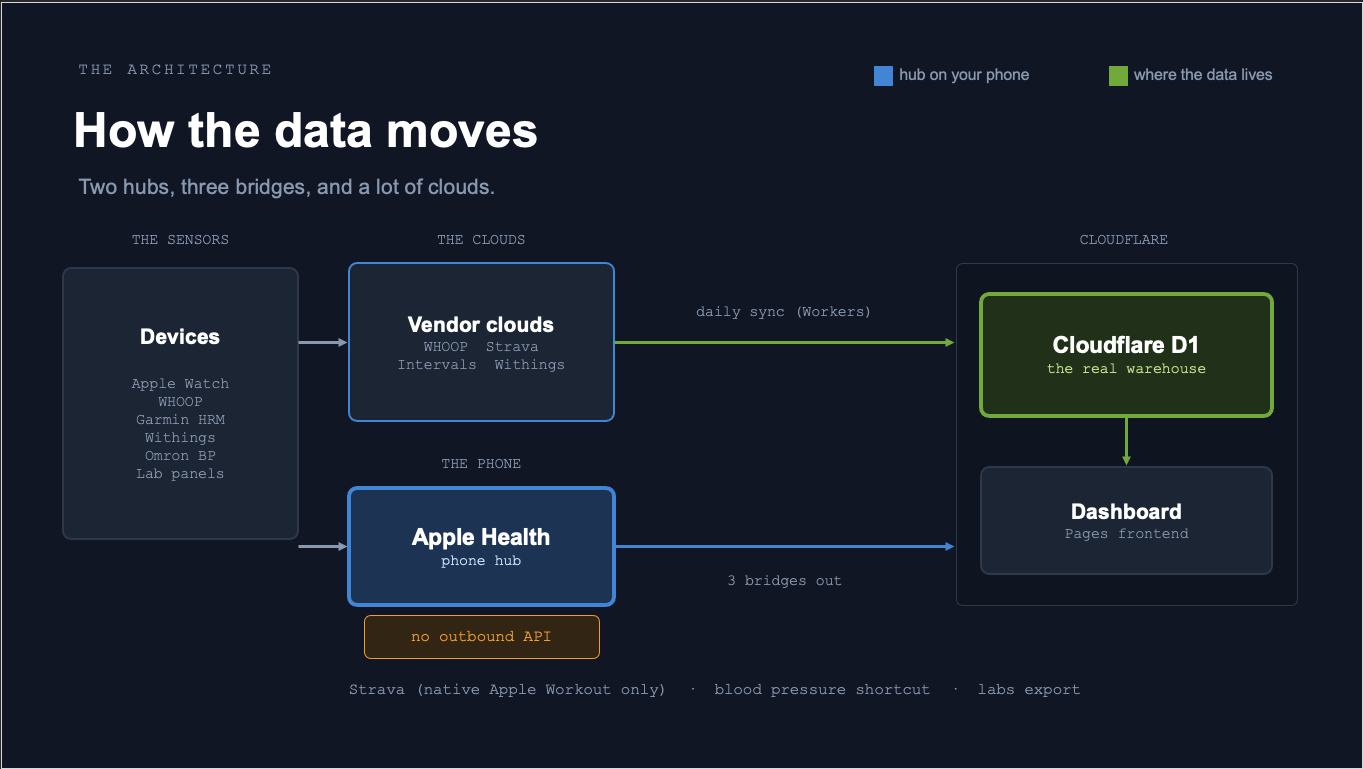
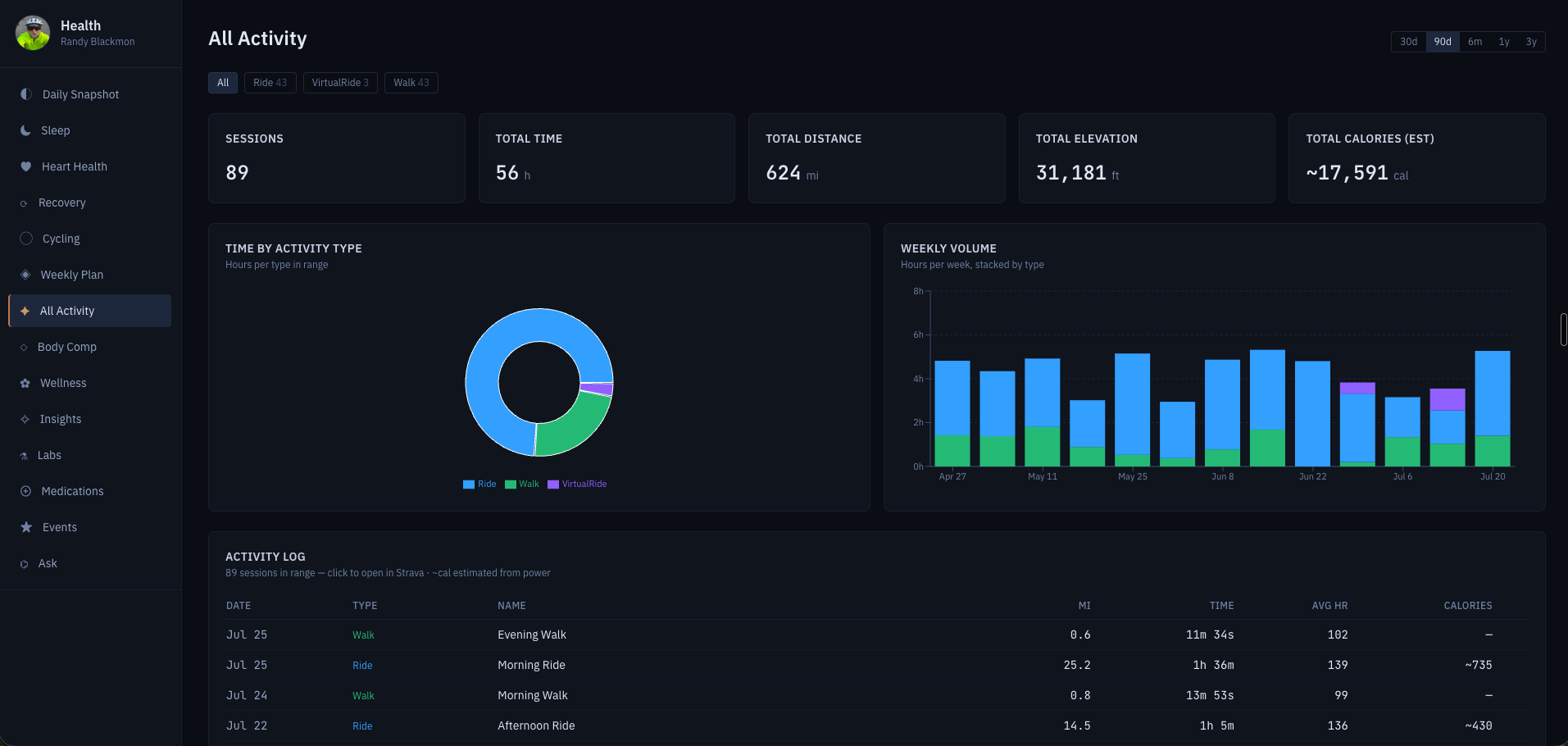
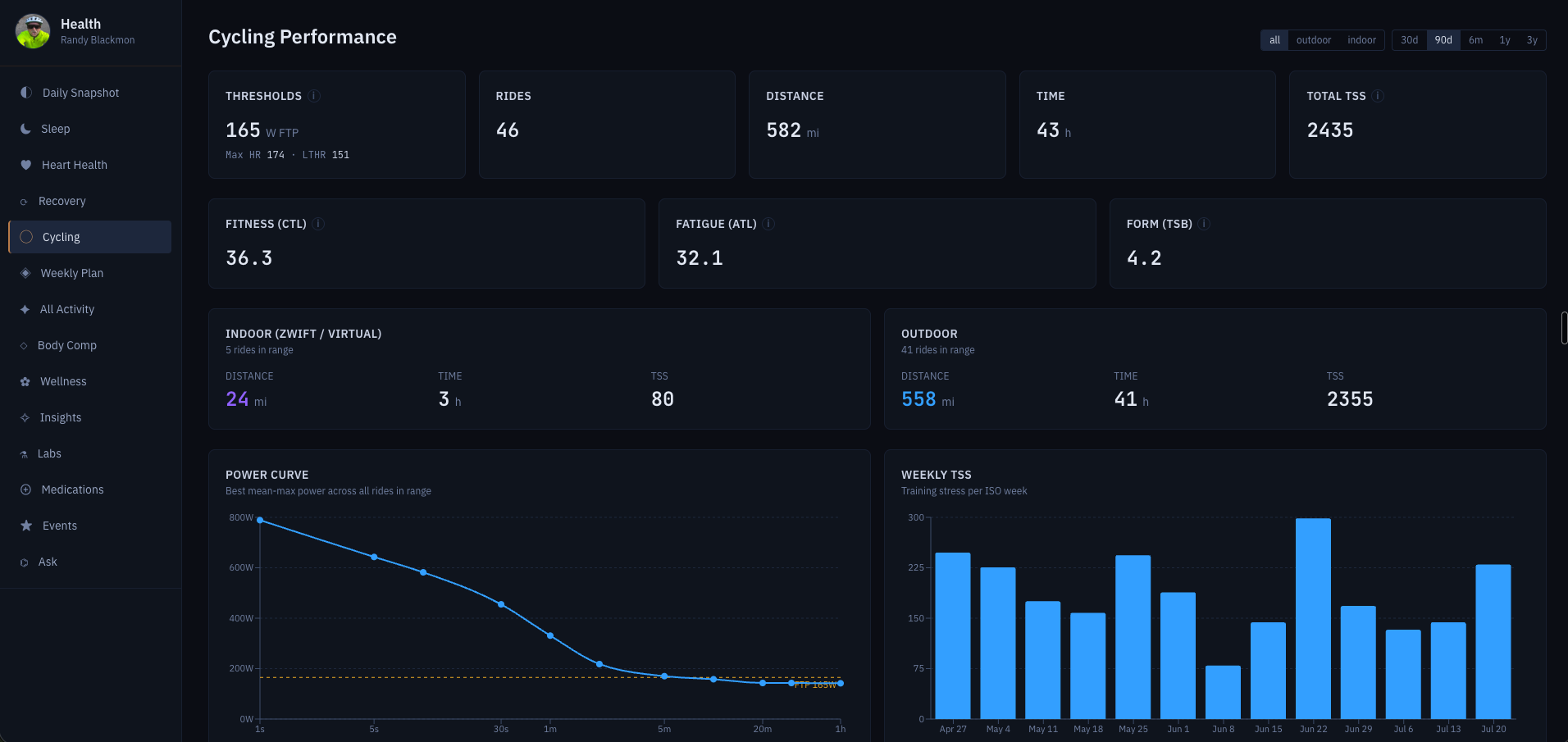
Over a few weeks of evenings, I designed and shipped a full-stack data platform: six source systems pulled into one place, normalized, and served through a live dashboard. It runs entirely on Cloudflare's edge, with scheduled jobs, APIs, and webhooks moving data between services and a single database holding the source of truth.
The dashboard brings together my training and health data from a handful of places I already use: Apple Workouts, Strava, WHOOP, Garmin, Withings, and a few others. Rides, sleep, recovery, heart rate, body composition, and lab results all land in one view instead of living in six different apps.
The subject was my own data, but the problem is one every operations leader will recognize. A pile of systems that do not talk to each other. No single source of truth. And data that refuses to move the way you assume it will. I expected one platform to be the natural hub, and it turned out to have no way to send data back out, so I had to architect around it.
Did I use AI to build it? Yes. I think that is the headline, not the asterisk. Being hands-on in 2026 is less about typing every line and more about making the architecture calls, directing the tools, checking their work, and owning the result when something breaks at 11 at night. I can walk you through every box in that diagram and tell you why it is there.
Leaders today are being asked to stay closer to the technology than they used to be, and I think that is the right shift. Successful technology leaders are the ones who keep learning, who stay curious about how the technology actually works. After 25+ years in this field, I am still putting in the time to learn and go deeper, so I can stay hands-on.
July 13, 2026
Working From Home: The Real Setup
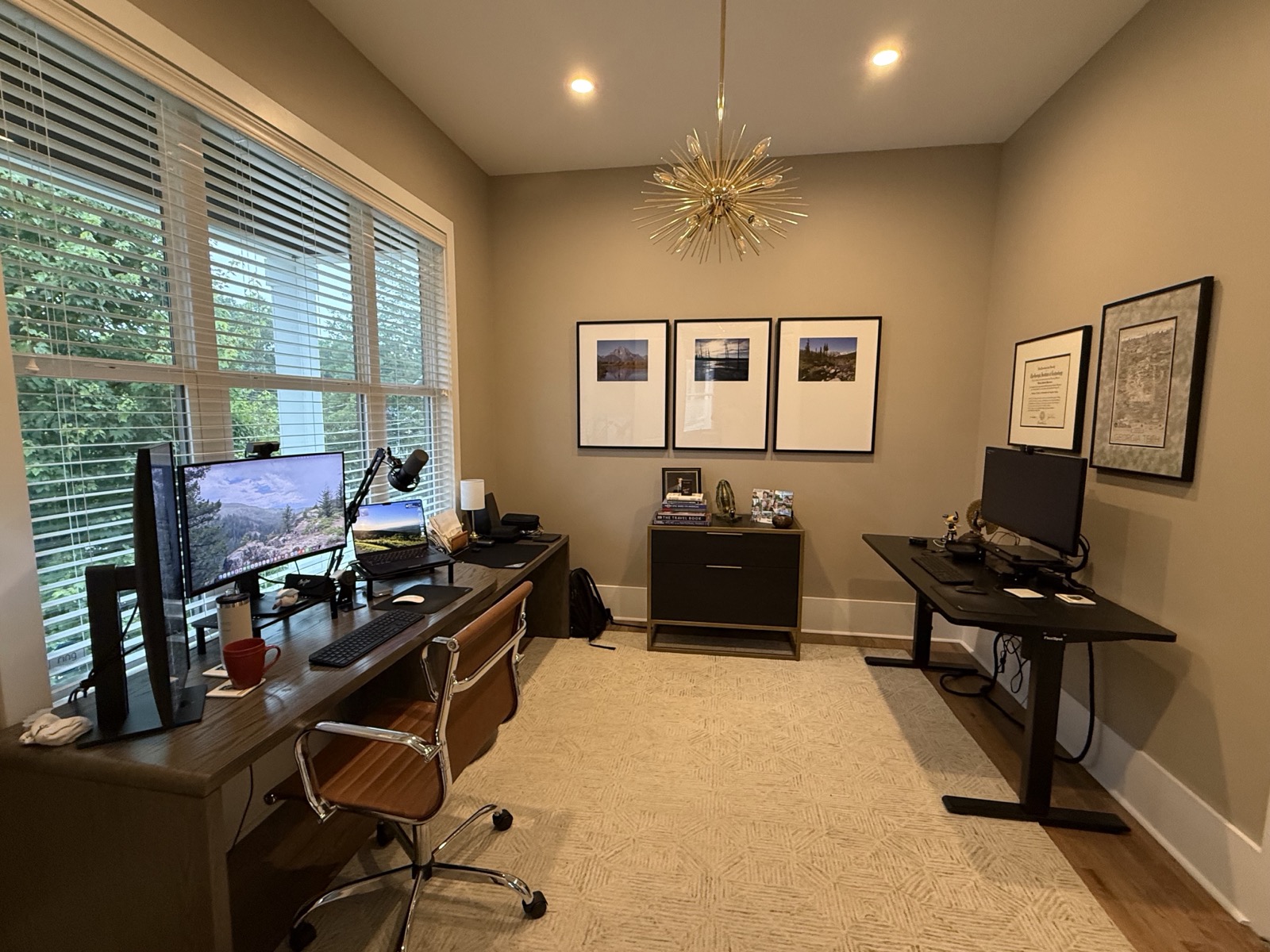
After 25+ years in IT leadership, you'd think my home office would look like something out of a tech magazine.
It almost does.
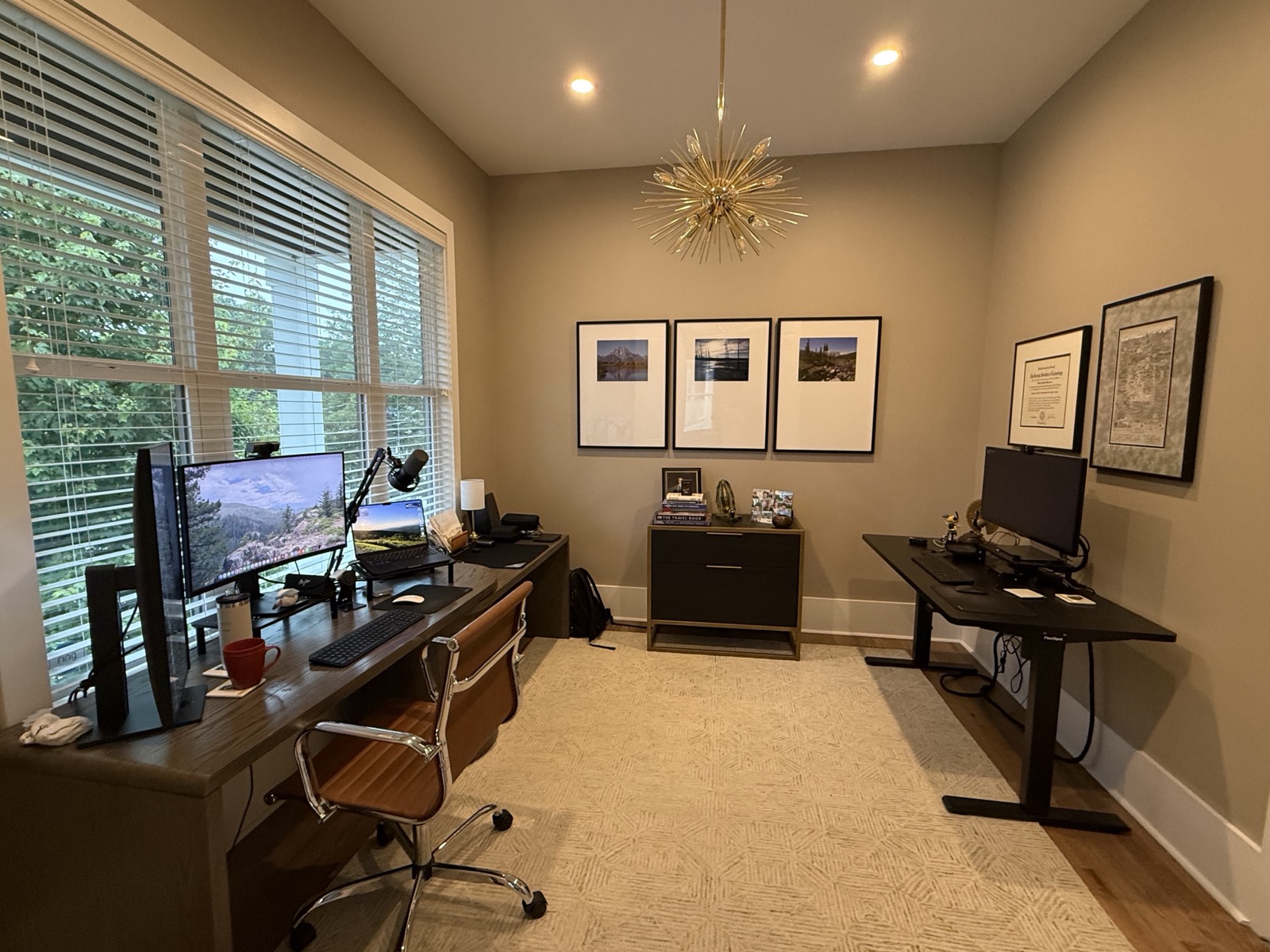
A MacBook Pro driving two monitors, one landscape and one portrait. The little Linux PC I built for my OpenClaw AI project humming along in the corner. A boom mic that makes me sound far more important than I actually am. From the shoulders up, I look extremely professional.
What you don't see on camera:
The bowl of Spaghetti O's I just microwaved for lunch. I have eaten Spaghetti O's since I was a kid. I am a senior technology executive. I have led global teams across four continents. And I still believe a can of Spaghetti O's is one of the finer lunches a man can have. I will not be taking questions on this.
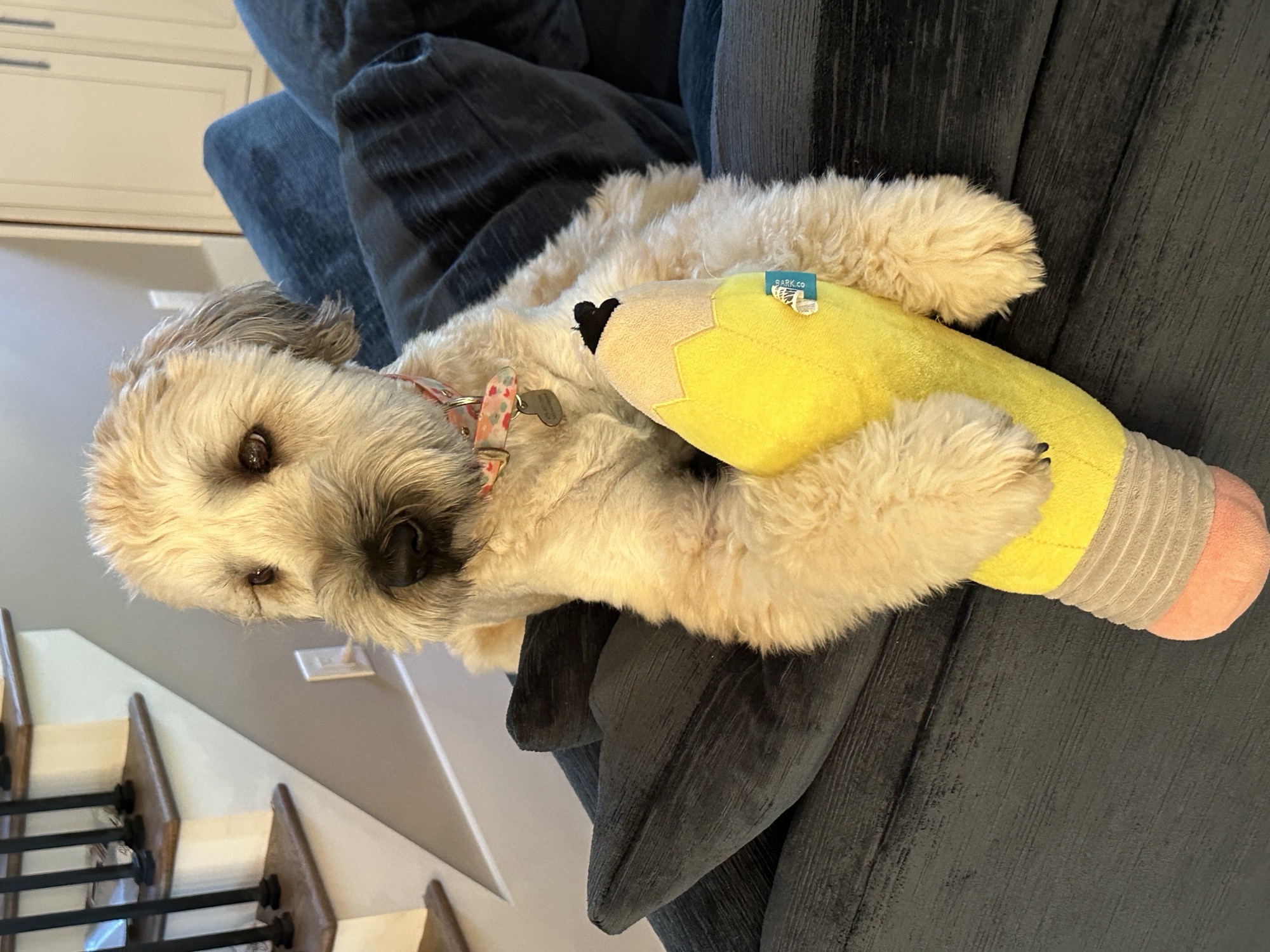
You also don't see Stella, my soft coated wheaten terrier, who has appointed herself Chief Security Officer of the household. Her job description is simple: bark at anything that approaches the front door. UPS driver? Bark. Amazon driver? Bark. A leaf moving suspiciously? Bark. A neighbor walking past three houses down? Also bark, just in case.
She does this with full commitment, ideally about 30 seconds into an important call.
Now, I would love to tell you that I have a beautifully designed system of boundaries between work and home. A color coded calendar. A "do not disturb" light over the office door. A signed treaty with the dog.
I do not.
What I actually have is my wife, who knows when I have an important call and quietly relocates Stella to the back porch before things get loud. That is the entire system. It works because she makes it work. (Thank you, Jenn.)
Working from home is a gift, in the right situation and for the right kind of work. The commute is unbeatable, the coffee is better, and you can wear shoes that have never seen the inside of an office. But I'm not a believer in doing it 100% of the time. Some things need a room and a whiteboard and the people who matter sitting across from you. I've come to believe hybrid is where the real answer lives.
It also takes some real discipline, or in my case, some real help from the people who live with you.
My question for you: When you've had the chance to work from home, what made it work for you? Both the setup at home and the way you handled it professionally.
June 22, 2026
Twelve Years at Coca-Cola, and What Staying Taught Me
I joined The Coca-Cola Company in 1992 and stayed for twelve years. In a market where people often change jobs every two or three years, twelve years can sound like a long time. Some people would say too long. I would say it was exactly right, and I'm grateful for almost every minute of it.
I was originally hired into a US based role supporting US business. On my first day, I told my new boss that I wanted international experience. Within two months of joining, I was in Brazil for two weeks building a wide-area data network.
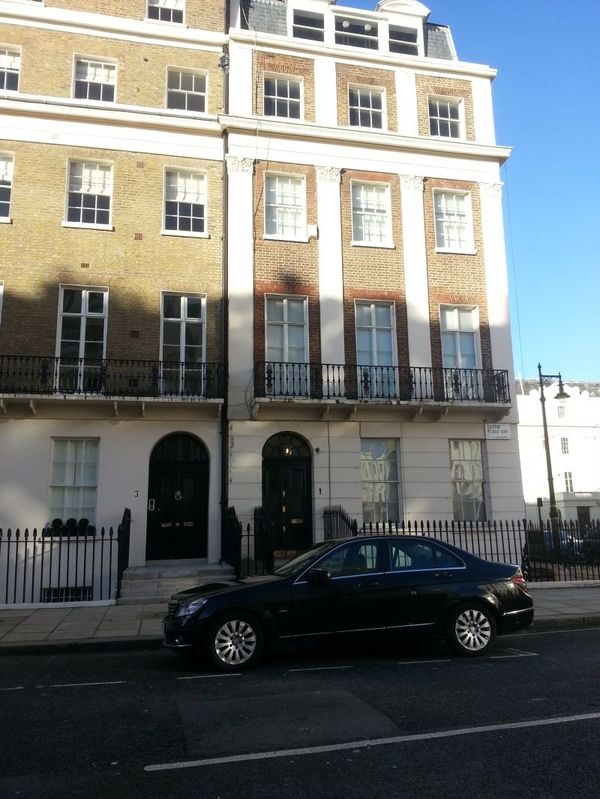
In 1994, I moved to London for a year. In 1997, I moved to South Africa. Along the way I traveled to places I'd only read about, met people I'm still in touch with thirty years later, and got to see how one of the world's most recognizable brands actually operates around the globe.
But the thing I remember most was a lesson.
In my time in South Africa, I watched how Coca-Cola built marketing and distribution for an entire country at once. South Africa has deep poverty, a growing middle class, and significant wealth, often within a few miles of each other. Coke built strategies for all three at the same time. Large scale brand marketing for some. On the street, neighborhood by neighborhood marketing for others. Different price points. Different packaging. Different distribution. One country, one brand, three different go to market approaches running in parallel.
I had never seen anything like it. And I would not have seen it in year two.
That's the thing about tenure that doesn't get talked about enough.
In year two, I was a technical person doing technical things in interesting places. In year seven, I was watching a business operate at a level of sophistication that took years to develop. By year eight, I was in Houston with The Minute Maid Company, learning how to apply technology to actual business problems on top of running IT systems. Each of those steps required the one before it. None of them would have happened if I had left the Company at the two-year mark for a slightly bigger title or a slightly bigger paycheck.
I'm not saying everyone should stay somewhere for twelve years. People and companies change, and sometimes leaving is exactly the right call. But I do think tenure is undervalued in today's market, and I think companies have a role to play in earning it. Better compensation as people grow. Cultures worth staying in. Benefits that recognize loyalty as something a company should invest in.
The best parts of my career came from staying long enough to be trusted with things I wasn't ready for on day one. That trust took years to build. And it paid me back many times over.
My question for you: What's the longest you've stayed somewhere, and what did staying give you that moving on couldn't have?
June 1, 2026
Operational Discipline at Small-Company Scale
Recently, I launched Timberline Technology Partners, a consulting firm built around my experience in IT operations, cybersecurity, cloud, and infrastructure leadership. Since then, I have been working with my first clients, and I am learning as much as I am delivering.
Here is what is standing out to me early on.
Small companies can build the same operational discipline that large enterprises have but it has to be shaped for the size of the company.
I spent most of my career inside large organizations with big budgets, dedicated teams, and established frameworks for things like change management, capacity planning, incident response, security and others. When I started working with smaller companies, I assumed those disciplines would be there. Not in all cases. Not enough people, not enough money, not enough time.
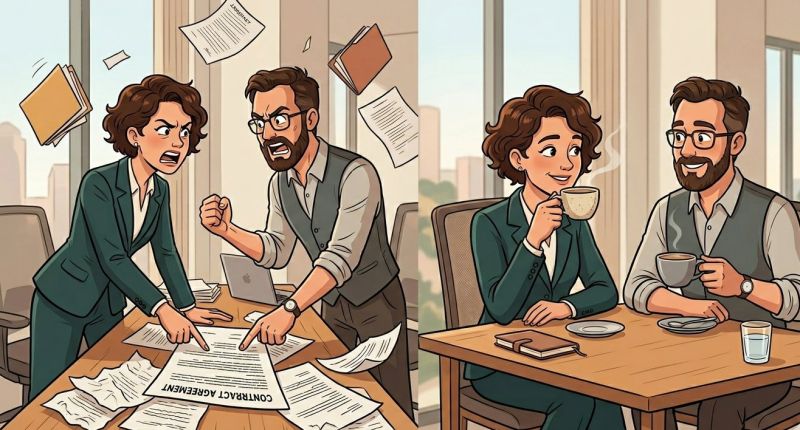
What I am finding is that the disciplines themselves are not expensive. The large enterprise versions of them are. A small company does not need a 40-page change management policy. But they do need a simple, repeatable process that keeps changes from breaking things in production. They do not need a dedicated capacity planning team. But they do need someone asking "are we going to run out of capacity in six months?" on a regular basis.
Another area where this matters is security. It does not matter how small you are. Your products and your customers' data need to be protected. That often means a CTO or technical leader has to make the case to the CEO that security is an investment, not an expense. That conversation can be uncomfortable, but it is one of the most important conversations a small company can have.
What has surprised me most is how much these companies are doing with very little. Small teams, tight budgets, and still building real products and serving real customers. That is not easy. It also means every dollar and every hour has to count, which is exactly why lightweight, practical operational discipline matters so much. You cannot afford to waste time fixing things that a simple process would have prevented.
I am incredibly grateful for the early trust my clients have put in me and Timberline. The work is challenging, it is different from what I did in the Fortune 500 world, and I am enjoying every bit of it.
My question for you: If you have worked in both large and small companies, what is one thing you wish small companies did more of?
March 22, 2026
Business Travel: Get Out and See the World
I see so many friends and colleagues post about business travel. I remember the first time I traveled for work. I was excited, energized, and ready to see the world.
And so I went to Saskatoon, Saskatchewan, Canada. A nice place (especially in the summertime).
Since then, I have been fortunate to continue to travel far more than I ever imagined: London, Brussels, Paris, Johannesburg, Lagos, Nairobi, Tokyo, Hartford, New York, Minneapolis, Calgary, Düsseldorf, Manila, Bangalore, and on and on. I even lived in a few of them.
My advice: if you can get out and see the world, do it. I learned so much about diversity, culture, and people. Europeans taught me that work-life balance is a discipline. And all of it positively shaped the employee, manager, executive, husband, and father I am today.
My question for you: When you travel for business, what are your tricks for making it go smoothly? Mine: always know where your critical documents are, keep a paper copy of your passport, and never rely solely on electronics for key logistics. Phones die. Laptops get lost. Paper does not.
And funny travel stories? I have got one.
I was once chased by an elephant. Not metaphorically. An actual elephant.
March 15, 2026
Sharpening the Saw: Diving Into AI
While I am actively looking for my next role, I am also "sharpening the saw," as Stephen Covey would say.
With AI front and center of most people's minds these days, I have been diving deep into ChatGPT, Grok, Gemini, and Claude while also learning about prompt engineering, agentic AI and API integrations.
But the most fascinating (and occasionally frustrating) project? Building a personal agent called Openclaw on a machine running Ubuntu Linux.
It took two weeks of playing, tinkering, and rebuilding the environment four times, but the result was challenging, educational, and fun.
I have not really been that geeky since my days at Scientific-Atlanta building IBM PCs and my early days at Coca-Cola connecting Wellfleet routers to speedy 56k circuits with Synoptics Token-Ring hubs.
It is amazing to see what agentic AI can do today and where it is headed. There is no better way to understand this shift than to get under the hood yourself.
I am also playing with some of the new AI video generation technology. I used RunwayML to create a clip of my dog Stella walking in Manhattan.
My advice: Play. Tinker. Build. Rebuild. Have fun. And most importantly, learn.
My questions to you: What are you doing to "sharpen your saw"? I would love to hear how others are looking to improve their current skills or learn a new skill.
March 8, 2026
Taking a Deliberate Pause
Right after I left my last role, my first instinct was not to look ahead towards that next role. It was to clear my head.
I have had the privilege of leading teams and technology at places like Coca-Cola, Morgan Stanley, Corning, and SunTrust (now Truist) among others. I loved the work. I love technology. But years of early-morning calls with Europe and Asia, weekend migrations, and escalations take a toll.
I decided to take some time to completely step away from the professional pace. No job boards, no LinkedIn (for the most part). Just skiing and snowmobiling in Colorado with old friends from Georgia Tech (Go Jackets!) and a friend from my days living in South Africa who now lives in Colorado.
My advice: Take the time, even a short one. Recharge. Then reconnect. It can help you to move forward with a clear and refreshed state of mind.
My question to you: Have you ever taken a break to recharge? What did you do? What did you learn?
April 16, 2026
Company Culture: What They Say vs. What You Experience
Almost every company I have worked for talks about culture.
After 25+ years working across Fortune 500s in consumer goods, financial services and manufacturing, along with smaller companies, I have come to believe that culture is not what is on the careers page. It may not be evident in the values printed on the wall. It may not be what the hiring manager tells you in the interview.
Culture is what is rewarded, and not always what is written.
I have seen organizations where the stated culture was "long term thinking" and "people first," but the daily reality was quarter to quarter pressure. Where "collaboration" was on the wall but constant escalation was the norm. Exhausting!
I have also worked in places where the culture was genuinely strong. Where people treated each other with respect, even when they disagreed. Where your manager remembered that you had a life outside of work. Where doing the right thing was more important than looking good in front of leadership.
How can you tell the difference before you sign? A few signals I have learned to watch for:
Do people stay, or do they leave as soon as they can? Retention patterns say more than any value statement.
How are disagreements handled? In healthy cultures, people can push back respectfully without fear. In unhealthy ones, dissent gets you sidelined.
What happens when someone makes a mistake? In strong cultures, the response is "what did we learn?" In weak ones, it is "whose fault is it?"
How do leaders talk about their people when those people are not in the room? That tells you everything.
You do not stay in touch with a culture. You stay in touch with the people who made it a great culture.
My question to you: What is one signal, large or small, that helped you understand a company's real culture?
April 22, 2026
Vendor Governance Is Not Procurement
I've been fortunate to lead large vendor relationships across several companies. One lesson keeps coming back.
Vendor governance and procurement go hand in hand, but they are not the same thing.
A few things I have learned from my experience:
Vendor culture matters.
You are not just buying services. You are buying the behaviors, values, and decision making of another company. I've seen contracts with everything spelled out perfectly on paper fall apart because the vendor's culture did not match the work. I've also seen simple contracts succeed because the two companies actually worked well together.
Evaluate vendor culture the same way you evaluate your own company's culture. It will tell you more about how the relationship will actually run than any SLA table.
Manage to the contract.
Over time, the contract should become a reference. At the start of a new relationship, the contract is your guidebook. It's the project plan for the transition, the scorecard for early deliverables, and the framework everyone needs to align around. That's appropriate.
But once things are steady, the contract can move to the background. Two healthy companies in a good partnership should have trust and flexibility to solve problems together. If you're still beating each other up with the contract two years in, something is wrong.
Trust is earned, not assumed.
Trust gets built the way it always does: by being honest about what a vendor can and cannot do, by delivering what was promised, and by doing what you said you would do. Small wins compound. Honest conversations during hard moments compound even faster.
I once had a vendor try to completely renegotiate a contract before they had delivered anything. My response was simple: if you want to renegotiate while you are still at zero, I will terminate for cause. They delivered most of the contract. And once they did, I provided real flexibility on the rest. Trust worked both ways. But it had to be earned first.
Vendor governance and procurement are two essential and different disciplines. Procurement gets the right deal done. Governance makes sure that deal delivers value over time. Companies that invest in both build the kind of partnerships that last for years.
My question for you: What's the best or worst vendor relationship you've been part of, and what made the difference?
Beyond the work
An adventurous technologist at heart.
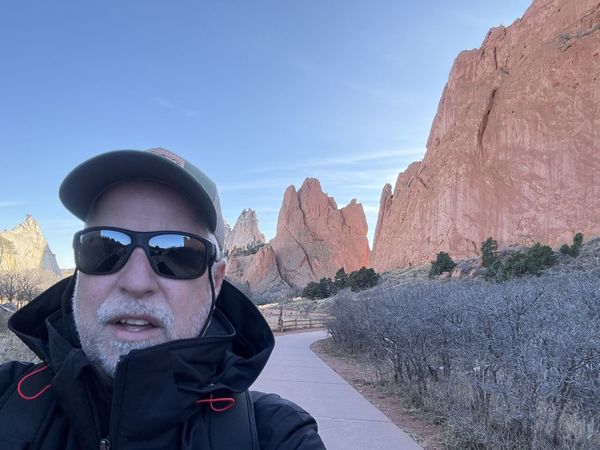
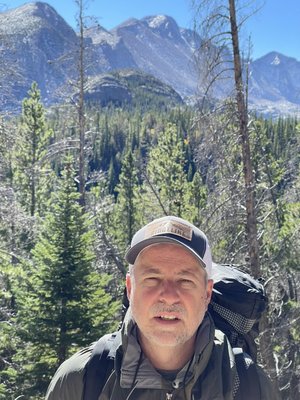
I am a Georgia Tech graduate with roots in Atlanta and a career that has taken me around the world, including assignments in London and South Africa. When I am not solving business problems with technology, you will find me on a trail in the Colorado Rockies, on a bike ride through the North Georgia hills, or on a golf course somewhere in between.
The curiosity that drives me to explore new places is the same curiosity I bring to every engagement. Looking past the obvious path to find the right one is a mindset that shapes everything Timberline does.
Contact
Need senior IT leadership without adding another executive?